Tuesday, Sep 15, 2026
 International Journal of Multidisciplinary Health Sciences and Research
Online ISSN: 3048-9997
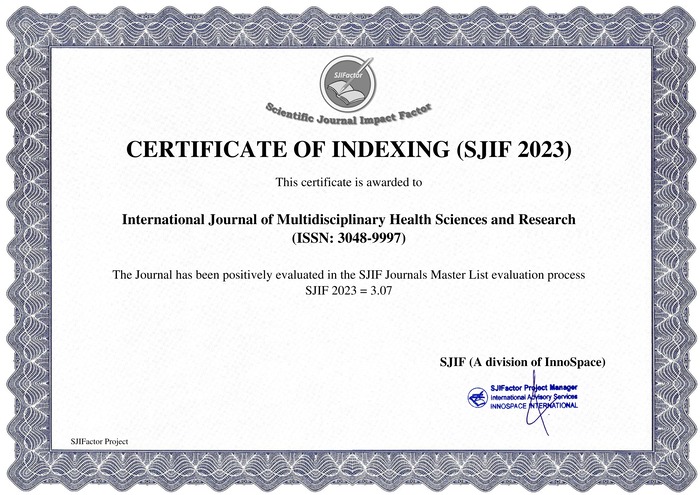
Impact Factor: 3.07 (SJIF 2023)
Impact Factor: 3.07 (SJIF 2023)
There is no fee for submitting and processing your manuscript with the IJMHSAR. For publication in the IJMHSAR, it is important to include the following points in all submitted manuscripts: 1. First page 2. Article page 3. Tables & Figures 4. A scanned copy of ethical clearance certificate 5. Undertaking by authors & copyright transfer agreement. The details are provided below.
Please ensure that the file contains a Covering letter, Title page, and Author's contribution. When submitting your paper, it is important to provide a clear overview of why it is best suited for publication in the IJMHSAR, as opposed to a specialty journal. It is important to designate one of the authors as the corresponding author for the paper. This individual will be responsible for both the content of the paper and communication with the Editorial office. The author must clearly state that the article has not been published or is currently being considered for publication, in whole or in part, in any other journal or conference proceedings. The title page should include the names of the author(s), their highest degree, the name(s) of the department(s), the academic positions of the authors in the department, the complete postal addresses, mobile numbers, and email addresses of all authors, and the name of the corresponding author with all the aforementioned details. The title page should include during manuscript submission: (i) Type of manuscript: original article/ review/ correspondence/ perspective/ view point/ clinical image/ letter to editor; (ii) Title; (iii) Short title; (iv) Number of Tables; (v) Number of Figures; (vi) Source of financial support in the form of grants; (vii) Registration number in case of Clinical Trials. The author's specific contribution should be acknowledged on the Title page.
Title: The title of the article should be brief, continuous (no broken or hyphenated titles), and descriptive and informational enough to be effective in indexing and information retrieval. A short running title not exceeding 6-7 words must also be provided. Abstract & Key words: It is recommended that all manuscripts, excluding reviews article, include a structured abstract of approximately 250 words. The abstract should be organized with subheadings for Background & objectives, Methods, Results, and Interpretation & conclusions. The abstract should be concise and provide an overview of the paper's scope and important findings. The focus should be on highlighting the main findings and conclusions, allowing abstracting services to use it as is. It is important to avoid including conclusions and recommendations in the Abstract that are not supported by the text of the articles. A set of suitable key words (4-8 in number) arranged alphabetically should also be provided.
Introduction: The introduction should be concise and clearly outline the paper's scope. Reviewing the literature should focus solely on the reasons for conducting the current study and provide only the most crucial background information. It is important to ensure that the objective of the study is clearly stated and justified at the end of this section.
Material & Methods: It is important to clearly mention the nomenclature, source of material and equipment used, along with the manufacturers' details in parenthesis. It is important to clearly state the procedures so that other workers can easily replicate the results, if needed. It is important to provide thorough descriptions of new methods, including any limitations they may have. When discussing established methods, it is important to provide authentic references and, if applicable, explain any significant deviations and the reasons behind adopting them. When reporting experiments on human subjects and animals, it is important to clearly state that the procedures followed adhere to the ethical standards set by the national bodies or organizations of the respective country. When conducting research in India involving human subjects, it is important to follow the ICMR's Ethical guidelines for biomedical research on human participants (2017). When conducting experiments on laboratory animals, it is important to adhere to the guidelines set by reputable organizations such as the ICMR, INSA, or CPCSEA. These guidelines provide valuable instructions on the proper care and use of animals in scientific research. It is essential to provide sufficient information regarding the care and use of laboratory animals, including details on their source, strain, age, sex, housing, and nutrition, among other factors. It is important to ensure that the necessary certification is included when submitting manuscripts. It is essential to provide accurate and detailed information about the drugs and chemicals used, including their generic names, dosages, and routes of administration.
Study Design: It is important to clearly mention the selection process for observational or experimental participants, which includes patients or laboratory animals, as well as controls. This should also include information about whether the selection was random or consecutive. Additionally, the basis for calculating the sample size should be provided, along with eligibility and exclusion criteria, and a description of the source population.
Period (with month and year) and place of the study should be clearly stated.
Contributors may consult the following Guidelines for specific study designs:
| Sr. No. | Type of study | Source |
| 1 | Randomized controlled trials (RCTs) | CONSORT- http://www.consort-statement.org |
| 2 | Systematic reviews & meta-analysis | PRISMA guidelines - http://www.prisma-statement.org |
| 3 | Observational studies in epidemiology | STROBE - http://www.strobe-statement.org/ |
| 4 | Meta-analysis of observational studies in epidemiology | MOOSE - http://statswrite.eu/pdf/MOOSE%20Statement.pdf |
| 5 | Studies on diagnostic accuracy | STARD - http://www.stard-statement.org |
Clinical trials study: It is essential for all clinical trials to be registered in a Primary Clinical Trial Registry and for the Registration number to be provided under Material & Methods. This ensures the transparency and credibility of the studies based on clinical trials. Articles that present results of randomized clinical trials should include comprehensive information about key study elements. This includes details about the study protocol, how interventions were assigned (such as methods of randomization and concealment of treatment group allocation), and the method of masking (also known as blinding). The CONSORT Statement (http://www.consort-statement.org/) provides guidelines for reporting these elements. It is important to note that the study protocol was approved by the institutional/local ethics committee and written consent was obtained from the participants.
It is important to mention the statistical analysis conducted and the statistical significance of the findings, when applicable. Unless it is essential for a clear understanding of the article, it may be best to avoid providing a detailed description of statistical treatment. When it comes to articles that heavily rely on statistical considerations, it is important to provide detailed information, especially when using new or uncommon methods. Authors should provide authentic references for standard and routine statistical methods used.
It is important to ensure that the data is organized in a consistent and logical manner to enhance the clarity and coherence of the report. It is important to avoid duplicating data from Tables and Figures in the text. It is crucial to highlight or condense only the significant observations. The same data should not be presented both in tabular and graphic forms. It is important to note that the interpretation of the data should be reserved for the Discussion section, rather than being included in the Results section.
The discussion should focus on interpreting the results, avoiding repetition of information already covered in the Results section. It is important to establish connections between new findings and existing knowledge, while also incorporating logical deductions. It is important to address any weaknesses, limitations, or gaps in the study. The conclusions are aligned with the goals of the study. However, it is crucial to avoid making unqualified statements or drawing conclusions that are not fully supported by the data. Avoid claiming priority on ongoing work. It is important to clearly identify any hypotheses that are warranted. Recommendations should only be included in the Discussion if they are absolutely necessary and relevant. It would be ideal to conclude this section with a final remark.
Acknowledgement should be concise and limited to particular scientific/technical support rather than normal departmental facilities and encouragement or aid with paper preparation (including typing or secretarial assistance).
Funding support and/or sponsorship received from national or international funding agencies should be acknowledged.
All authors are required to disclose any financial and personal relationships with other individuals or organizations that could improperly influence their work (bias). If no conflicts of interest exist, authors should state so.
The referencing style of the journal typically follows a specific format to provide clear and consistent citations. The references should be written in the APA (American Psychological Association) style. Here is an example of APA referencing style:
citation:-
Single Author: (Smith, 2019)
Two Authors: (Smith & Johnson, 2020)
Three or more Authors: (Smith et al., 2021)
No Author: (Title of the Article, Year)
Multiple Works by the Same Author in the Same Year: (Smith, 2019a; Smith, 2019b)
Reference List:
Journal Article:
Smith, J. D. (2019). Title of the article. Journal Name, Volume (Issue), Page numbers.
Smith, J. D., & Johnson, K. L. (2020). Title of the article. Journal Name, Volume (Issue), Page numbers.
Book
Smith, J. D. (2018). Title of the Book. Publisher.
Chapter in an Edited Book:
Smith, J. D. (2017). Title of the chapter. In A. B. Editor & C. D. Editor (Eds.), Title of the Book (pp. Page numbers), Publisher.
Online Article:
Smith, J. D. (2021). Title of the article. Journal Name, Volume (Issue), Page numbers. DOI
Smith, J. D. (2022). Title of the article. Journal Name, Volume (Issue), Page numbers. Retrieved from URL
Website:
Smith, J. D. (2016). Title of the webpage. Website Name. URL
Thesis or Dissertation:
Smith, J. D. (2015). Title of the thesis/dissertation (Doctoral dissertation). University Name.
Tables must be consecutively numbered using Roman numerals (I, II, III, etc.). They should have concise titles, and column headings should be brief as well. The abbreviated units of measurement should be written beneath the headings. Variations in statistical measurement, such as SD and SE, should be identified. Avoid the inclusion of structural formulas in Tables. Include abbreviations in the footnote.
Illustrations should be submitted in JPEG or TIFF format (with a file size of no more than 1 MB), numbered consecutively in Arabic numerals, and accompanied by an appropriate Title and explication of symbols in the inscriptions. In the upper left corner of a multi-panel diagram, various portions should be labeled A, B, C, etc.
Photomicrographs should have internal scale markers for magnification details to facilitate final print reduction. In photomicrographs, symbols, arrows, and letters should be legible and contrasted against the background. As Figures, JPEG/TIFF-formatted graphs can be uploaded.
All published materials must be acknowledged, and copyrighted materials must be submitted with the copyright holder's written permission.
Only standard abbreviations are permitted. Throughout the text, tables, and figures, the abbreviations should adhere to the International System of Units (SI). The drugs' generic names should be used. If proprietary trademarks are used in research, the brand name, manufacturer, and country should be included in parentheses following the generic name at the first occurrence.
All studies involving patients, volunteers, human biological material, or animals must submit a scanned copy of their Ethical Clearance Certificate.
The International Journal of Multidisciplinary Health Research envisions becoming a leading platform for the dissemination of high-quality research in all areas related to health, with the aim of improving health outcomes globally.


International Journal of Multidisciplinary Health Sciences and Research ©
2026 is licensed under Attribution 4.0 International
To view a copy of this license, visit http://creativecommons.org/licenses/by/4.0/
© IJMHSAR. All Rights Reserved. Designed by Abhimanyu Singh